Sump pumps, and why the backup is the one people wish they had bought
A sump pump has one job and it always has to do it on the worst night of the year.
September 22, 2026 · 3 min read
A sump pump is an unglamorous piece of equipment that quietly decides whether your basement is storage or a swimming pool. It sits in a pit, the lowest point of the basement floor, and water that would otherwise rise through the slab collects there instead. When the water reaches a set level, a float switch starts the pump and it pushes the water out through a discharge pipe to somewhere it can do no harm.
That is the entire idea. The complications are all in the failure modes, and they are worth understanding because they are the argument for the thing most people skip.
The pit and the pump
The pit matters more than people expect. It needs to be deep enough and wide enough that the pump is not switching on and off constantly, because short cycling wears a pump out faster than steady work. It also needs a lid: an open pit is an evaporation source, a smell, and a hazard.
The discharge line needs to take water far enough from the foundation that it is not simply making a loop back into the same pit, and it needs a check valve so the column of water in the pipe does not drain straight back down every time the pump stops.
How they actually fail
- The float switch jams, gets tangled, or is pushed against the side of a pit that is too narrow. The pump is fine and never gets told to run.
- Debris gets into the pit and into the impeller. A lid prevents most of this.
- The check valve fails, so the pump keeps cycling on water it already moved.
- The discharge line freezes or blocks, so the pump runs and moves nothing.
- The pump simply reaches the end of its life, usually while working hard.
- The power goes out.
Read that last one again, because it is the whole point. The weather that produces the most groundwater is the weather that brings down power lines. A sump pump is most likely to be needed at exactly the moment it is most likely to have no electricity. A perfectly healthy primary pump is useless in an outage, and that is not a maintenance failure you can inspect your way out of.
What a backup pump does
A backup pump is a second pump that does not depend on the first one working or on house power being present. It sits slightly higher in the pit, so in normal operation the primary handles everything and the backup never runs. When the primary fails, or when the water rises past the level the primary can keep up with, the backup takes over.
It also covers the failure nobody plans for, which is the primary dying of old age in the middle of a heavy week rather than politely during a dry spell.
Checking yours, twice a year
- Pour a few buckets of water into the pit slowly and watch the pump start, run and stop on its own.
- Make sure the float moves freely and is not fouled on the pit wall, the pipe, or the cord.
- Look in the pit for gravel, silt and debris, and clear it.
- Walk outside and confirm the discharge is actually running clear of the foundation.
- If you have a backup, test it separately, including simulating loss of power to the primary.
Do this in autumn before the wet season and again in spring before the melt. Both take ten minutes and both tell you something a visual inspection cannot.
The rest of the mechanical room
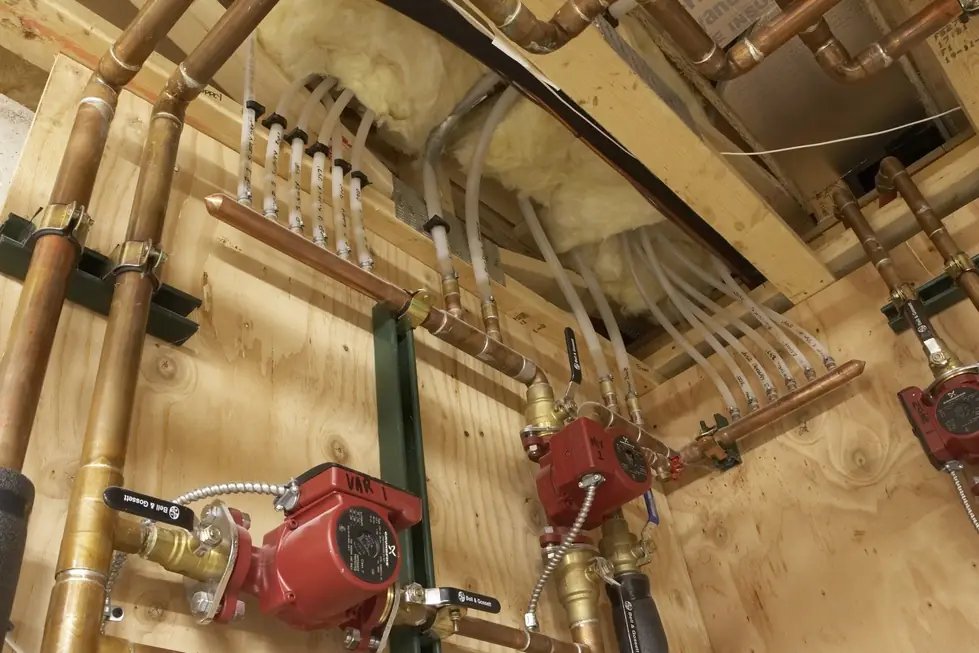
We fit standard sump pits, sump pumps and back up pumps, and we carry a one year warranty on the labor and the parts used. While we are down there we tend to look at the rest of it too: zone manifolds, circulators and the copper that ties them together. That is not the part of the house anybody shows visitors, and it is the part we are proudest of.
For commercial customers we also fit Schier grease traps, which is the equivalent piece of unglamorous equipment that stops a kitchen line backing up on a Friday night.
If you are not sure whether your pit has a backup, or whether the one in there still works, call the office and ask. We return all calls and emails within two hours, and estimates are free.
Keith Petersen Plumbing Inc, (920) 687-9272
Call (920) 687-9272More articles
Seven signs your water heater is about to fail
A water heater almost never dies without warning. It just gives the warning somewhere nobody looks.
Hard water: what a softener actually does, and what it does not
Softeners are widely sold and widely misunderstood. Here is the honest version of what the equipment in your utility closet is doing.