Hard water: what a softener actually does, and what it does not
Softeners are widely sold and widely misunderstood. Here is the honest version of what the equipment in your utility closet is doing.
September 22, 2026 · 4 min read
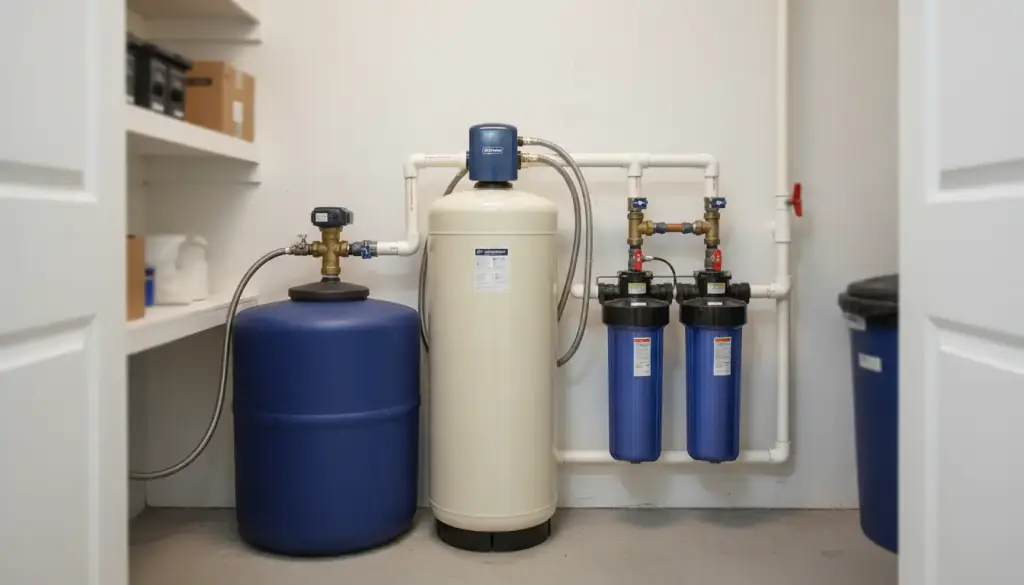
Hard water is water carrying dissolved minerals, mostly calcium and magnesium, picked up as it moves through rock and soil. It is not a contamination problem and it is not a health scare. It is a nuisance problem, and the nuisances are specific enough that most people can recognise their own water from a list.
How you know you have it
- Glasses come out of the dishwasher spotted or cloudy even on a good cycle.
- Soap and shampoo will not lather properly, and you use more of both than seems reasonable.
- A white or greyish crust builds on kettles, shower heads and faucet aerators.
- Laundry feels stiff and colours go flat faster than they should.
- Skin feels tight after a shower, as though there is still a film on it.
If a test shows your water is hard, the question is not really whether to do something. It is which piece of equipment solves which problem, because softening and filtering are two different jobs and they get sold as though they were one.
What a softener does
A conventional softener works by ion exchange. Water passes through a tank of resin beads that hold sodium or potassium ions. The calcium and magnesium in the water stick to the resin and the sodium or potassium is released in their place. What comes out the other side is water with the hardness minerals swapped for something that does not build scale or fight with soap.
The resin fills up, so periodically the softener flushes itself with a strong brine solution from the second tank, the one you add salt to. That strips the accumulated hardness off the resin, sends it down the drain, and reloads the beads. That is the whole cycle, and it is why a softener has two tanks and needs salt rather than a filter cartridge.
What a softener does not do
This is the part worth being clear about. A softener is a scale and soap problem solver. It is not a purifier. It is not designed to improve taste, and it is not a treatment for anything you would be worried about drinking. Softened water still carries whatever else was dissolved in it, and it now carries a small amount of sodium or potassium that the exchange put there.
So if the reason you are looking into this is that your water tastes bad, a softener on its own is very likely the wrong purchase, and anybody who tells you otherwise is selling rather than advising.
Where reverse osmosis fits
Reverse osmosis is the other half of the answer and it works on a completely different principle. Water is pushed against a semi permeable membrane whose pores are small enough that water molecules pass and most dissolved solids do not. The rejected material goes to drain and what comes through is genuinely stripped down water.
Reverse osmosis is normally fitted at the point of use rather than for the whole house, typically under the kitchen sink with its own small tap, because it is slower and produces some waste water. That suits it perfectly to drinking and cooking water and makes it a poor choice for showers and laundry. Softener for the house, reverse osmosis at the tap you drink from, is a very common and very sensible pairing.
Living with the equipment
- Keep the brine tank topped up and check it on a schedule you will actually keep, not when you remember.
- If the tank develops a solid crust of salt bridged across the top, break it up, because the softener below it may be regenerating with no salt reaching the water.
- Reverse osmosis membranes and pre filters are consumables. They have a service life and ignoring it slowly undoes the thing you paid for.
- If softened water suddenly starts leaving scale again, the problem is usually salt, a bridged tank or a regeneration setting, and not a dead softener.
Getting an honest recommendation
We carry Water-Right softeners and install reverse osmosis systems, and we service both afterwards, which is the part that matters five years in. We also sanitize water where the supply calls for it. We will never try to sell you a product or service you do not need, and we do not send a salesman to your property: the person who quotes the job is the person who fits it.
If what you want is water you know is pure, safe and fresh tasting, that is a conversation worth having properly rather than off a brochure. Call the office and ask. Estimates are free, and we return all calls and emails within two hours.
Keith Petersen Plumbing Inc, (920) 687-9272
Call (920) 687-9272More articles
Seven signs your water heater is about to fail
A water heater almost never dies without warning. It just gives the warning somewhere nobody looks.
What to check before you call a plumber
We would rather you solved a five minute problem yourself than paid us to. Here is how to tell which kind you have.